
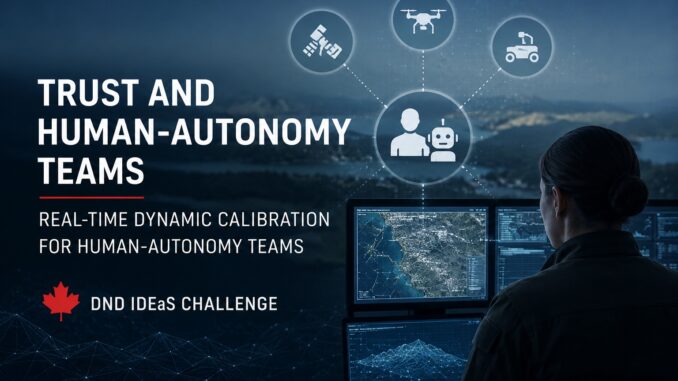
The Department of National Defence has launched a new Innovation for Defence Excellence and Security challenge focused on one of the emerging questions of the AI era: how humans and autonomous systems can work together effectively in complex operational environments.
The challenge, titled Cognition and Trust: Real-Time Dynamic Calibration for Human-Autonomy Teams, seeks Canadian-led multidisciplinary research teams to develop methods for assessing, measuring, and calibrating trust between humans and autonomous systems in real time.
As artificial intelligence becomes increasingly integrated into decision support systems, autonomous vehicles, robotics, intelligence analysis, and other mission-critical applications, organizations face a growing challenge. Too little trust in automated systems can result in underuse of valuable capabilities, while excessive trust can lead to overreliance and poor decision-making.
According to DND, the objective is to better understand and improve the dynamic relationship between human operators and autonomous technologies, particularly in situations where conditions, information, and levels of uncertainty are constantly changing.
While the challenge is being administered through Canada’s defence innovation program, many of the underlying research themes have direct relevance to the broader geospatial community.
Geospatial professionals are increasingly working with AI-enabled tools for Earth observation, geospatial intelligence, mapping, digital twins, predictive analytics, infrastructure management, and emergency response. In many cases, these systems are designed to support human decision-makers rather than replace them.
Why this matters to the geospatial community
The challenge raises questions that are becoming increasingly important across the sector:
- How can users understand the confidence level of AI-generated outputs?
- What information should systems provide to help operators make informed decisions?
- How can organizations determine when trust in an automated process is too high or too low?
- What metrics can be used to assess the performance of human-machine teams?
- How should autonomous systems adapt when operating conditions change?
The challenge also aligns with broader conversations taking place across Canada’s geospatial sector regarding digital sovereignty, trusted data infrastructure, artificial intelligence, and the role of human expertise in increasingly automated workflows.
Canadian universities, research organizations, technology companies, and interdisciplinary teams with expertise in artificial intelligence, cognitive science, human factors, robotics, geospatial technologies, and related fields may find opportunities to contribute to this area of research.
Additional information on the challenge, eligibility requirements, and application details is available through the Department of National Defence’s IDEaS program.
For the geospatial community, the initiative serves as another indicator that questions surrounding AI governance, human oversight, and trust in automated systems are moving from theoretical discussions into practical operational requirements.

Be the first to comment