
Week in Review: High-Altitude Banners
- The Dawn of Native Spatial Deep Learning: Milestones from Ghent GeoAI 2026
- The Low-Earth VLEO Race Opens: NewOrbit locks in $18.5M Series A
- GPS-Free Navigation Moves to the Grid: NSF deploys QuantumGrid in Chattanooga
- Democratization of Space Intelligence: Operational integration of China’s TEE-01B satellite
- Space Weather Sovereignty: European Commission issues closed orbital protection tender
- The Quantum Sovereign Vertical Stack: SEALSQ acquires Miraex SA
1. The Dawn of Native Spatial Deep Learning: Milestones from Ghent GeoAI 2026

Ghent University, Belgium – Host venue for the inaugural GeoAI 2026 World Congress.
The 1st International Conference on Geospatial Artificial Intelligence (GeoAI 2026) concluded in Ghent, Belgium, bringing together academic researchers and corporate GIS giants like Esri and HERE to tackle a persistent limitation: traditional AI models do not naturally understand geography. Up to this point, the “AI boom” in geomatics has largely meant wrapping general-purpose LLMs around geographic files, forcing software to treat coordinates as flat, tabular vectors.
At Ghent, developers debuted “knowledge-guided deep learning” frameworks. Instead of letting a neural network blindly guess patterns, core spatial concepts—such as distance decay, spatial scale dependencies, and physical landscape metrics—are now hardcoded directly into the AI’s architecture as a regularization signal. The conference also featured a dedicated track targeting data provenance, confronting the rising threats of untrusted or hallucinated spatial data pipelines.
The Strategic Repercussion: We are transitioning from software-centric GIS to model-centric spatial intelligence. By embedding geographic laws directly into AI code, the global market is building models that natively understand spatial topology, preventing geographically absurd or physically impossible predictions. To preserve digital and territorial sovereignty—especially when mapping critical infrastructure or monitoring shifting Arctic permafrost—Canada cannot simply depend on generic commercial API wrappers built by Silicon Valley tech giants. The domestic sector must invest heavily in training native, secure spatial foundation models that understand our unique geography.
Source: HeiGIT: GeoAI Conference 2026 – Knowledge-Guided Deep Learning Milestones
2. The Low-Earth VLEO Race Opens: NewOrbit locks in $18.5M Series A
Orbital mechanics breakdown showing the altitude tiers of Low Earth Orbit (LEO), serving as the baseline above Very Low Earth Orbit (VLEO) operations.
UK-based space startup NewOrbit finalized an oversubscribed $18.5 million Series A funding round to build out its “NEO Production Complex.” The capital is earmarked to mass-produce small satellites specifically engineered to operate within Very Low Earth Orbit (VLEO)—the atmospheric band sitting between 200km and 300km altitude. Historically considered a satellite graveyard due to severe atmospheric drag and corrosive atomic oxygen, NewOrbit is deploying proprietary, continuous-boost electric propulsion systems paired with specialized atomic-oxygen-resistant composite materials to extend a satellite’s operational lifespan to five years.
The Strategic Repercussion: Dropping down to 200km allows tiny, low-cost satellites to capture ultra-high-resolution imagery and achieve faster data transmission speeds at up to 20 times less cost than conventional constellations. This marks a disruptive force for Canadian Earth observation analytics firms. As European and Asian players commoditize sub-meter imagery at a fraction of today’s cost, Canadian data brokers relying on traditional orbital providers will face severe margin compression. Our domestic sector must rapidly adapt to ingest these low-latency, lower-cost VLEO data pipelines or risk losing critical infrastructure and Arctic monitoring contracts to foreign vertical stacks.
Source: TNW: NewOrbit Commercialises Very Low Earth Orbit Spacecraft
3. GPS-Free Navigation Moves to the Grid: NSF deploys QuantumGrid in Chattanooga
Pre-commercial fiber-optic synchronization arrays utilized to anchor city-scale quantum sensor nodes.
Shifting quantum technology out of isolated physics laboratories and directly into civic utility systems, the U.S. National Science Foundation (NSF) announced the active expansion of the QuantumGrid project in Chattanooga, Tennessee. The initiative uses existing underground fiber-optic telecommunication cables and automated power grids to connect and synchronize ultra-precise quantum sensors across a municipal footprint.
The Strategic Repercussion: By operating these sensors in a live, city-scale environment, engineers are mapping hyper-local gravitational and magnetic anomalies with unprecedented precision. This is a critical development in the international race to replace GPS. By creating highly detailed, un-jammable maps of Earth’s local quantum-gravitational “fingerprints,” nations are establishing the civil infrastructure required for autonomous navigation independent of satellite networks. For Canada’s defense frameworks, northern sovereignty, and underground mining corridors, absolute reliance on GPS is an existential vulnerability. Canadian geomatics engineers must establish matching quantum-gravitational reference frameworks to ensure our logistics networks are not locked out of continental defense architectures.
Source: NSF Science Matters: Moving Quantum Technology to the Grid
4. Democratization of Space Intelligence: Operational integration of China’s TEE-01B satellite
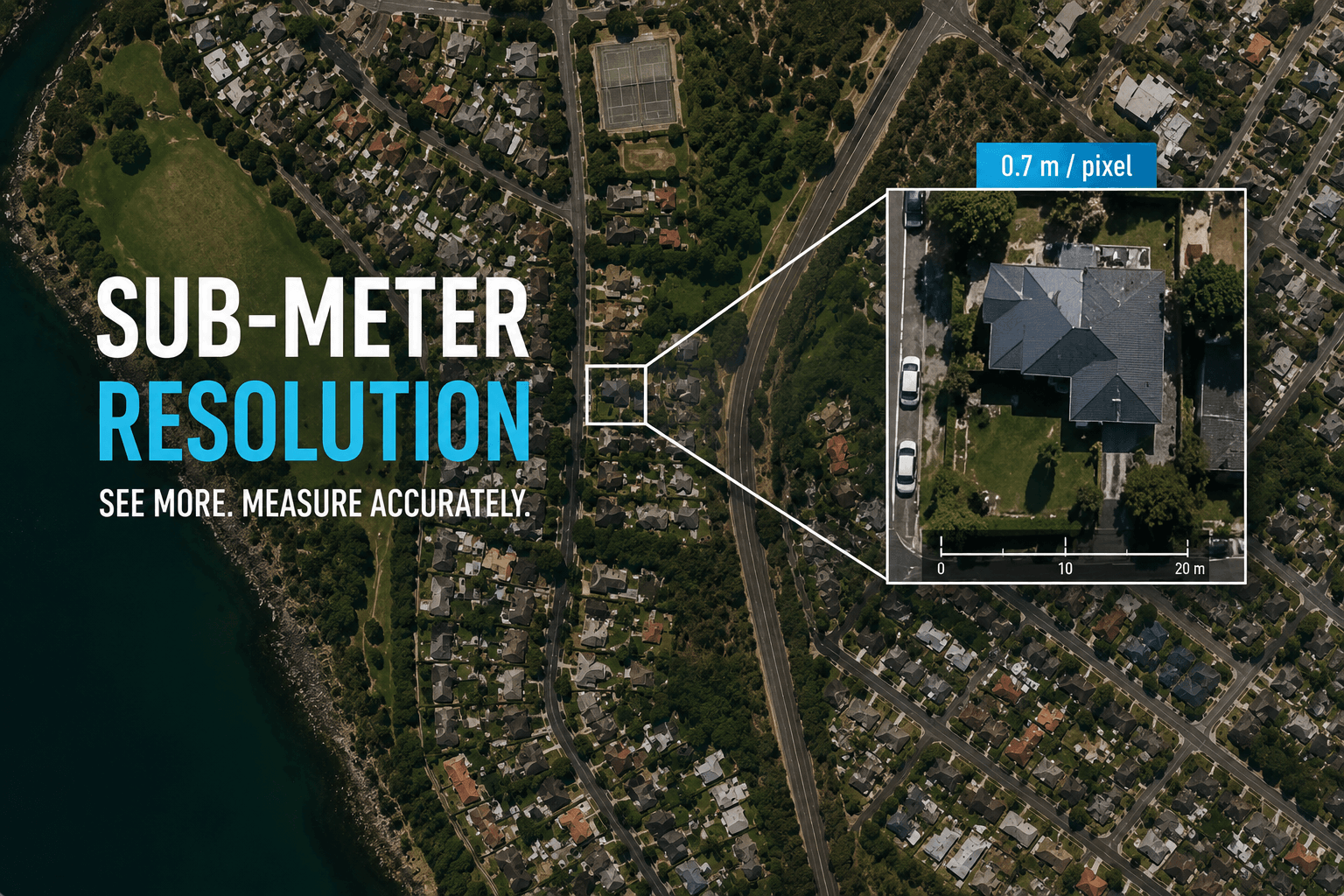
An operational example highlighting the granular spatial fidelity achieved via commercial sub-meter satellite arrays.
Verified intelligence briefs confirmed that the Chinese-manufactured TEE-01B Earth observation satellite has been fully integrated into the tactical strike and damage assessment workflows of non-Western regional state actors (specifically Iran’s IRGC). The TEE-01B is a highly optimized low-orbit asset capable of delivering 1.7-foot (sub-half-meter) panchromatic and 6.8-foot multispectral imagery. Satellite tracking data indicates that its imagery is being actively routed through a distributed network of international ground stations to provide real-time, high-resolution surveillance of allied military outposts and logistics hubs.
The Strategic Repercussion: High-tier orbital reconnaissance is no longer a monopoly held by Western superpowers or elite space programs. The wide commercial availability and secondary-market procurement of sub-half-meter spy assets mean that precision space surveillance has been completely democratized globally. This development fundamentally alters the counter-reconnaissance calculations for Canadian national security. Our remote northern resource corridors, critical industrial facilities, and Arctic military positions are completely visible to adversarial procurement pipelines. Canadian defense planners can no longer treat geographical isolation as a form of natural camouflage.
Source: Times Now World: Technical Analysis of TEE-01B Deployment and IRGC Workflows
5. Space Weather Sovereignty: European Commission issues closed orbital protection tender

Official institutional seal of the European Commission.
The European Commission officially published a high-value call for tenders for its sovereign EU Space Weather Service, creating a brand-new defensive data subcomponent within the broader EU Space Programme. The service focuses on building advanced, real-time predictive models to track solar radiation bursts and intense geomagnetic storms. These space weather events present severe operational hazards to modern space infrastructure, as they can cause rapid atmospheric drag that pulls satellites out of orbit, fry delicate onboard electronics, and heavily degrade the accuracy of global navigation satellite systems (GNSS).
The Strategic Repercussion: Space weather data has historically been treated as a collaborative, open-science domain, anchored by public agencies like NOAA in the United States. By transitioning this data into a tightly controlled, sovereign component of Space Traffic Management (STM), the EU is signaling that it will no longer rely on foreign environmental streams to protect its multi-billion-dollar Galileo and Copernicus constellations. Because of our high-latitude northern geography, Canada’s domestic power grids, pipelines, and communication networks are uniquely exposed to geomagnetic disruptions. As Europe builds a closed defensive data wall around its space assets, Canadian satellite operators and geospatial data providers will face intense pressure to meet strict European data-compatibility standards to remain eligible for transatlantic orbital missions.
Source: European Commission: EU Space Weather Service Procurement Framework
6. The Quantum Sovereign Vertical Stack: SEALSQ acquires Miraex SA


The corporate marks of SEALSQ and Switzerland-based photonic developer Miraex SA.
Global semiconductor and post-quantum cryptography firm SEALSQ announced the successful acquisition of Switzerland’s Miraex SA, a specialized developer of photonic quantum sensing hardware. The merger is explicitly designed to consolidate a “Quantum Sovereign Vertical Stack” and accelerate the deployment of SEALSQ’s planned Quantum Orbital Space Cloud (QOSC). By combining Miraex’s advanced photonic sensors with SEALSQ’s secure, quantum-resistant microchips, the newly unified entity aims to control every point along the data loop—from the physical sensor orbiting in space to the encryption hardware processing data on the ground.
The Strategic Repercussion: The era of the independent, boutique space-hardware startup is rapidly coming to a close. International giants are no longer looking to purchase standalone sensors from third-party suppliers; they are buying out entire vertical pipelines to guarantee closed, end-to-end, un-hackable data ecosystems that foreign adversaries cannot infiltrate. Canada boasts an incredibly vibrant, world-class cluster of independent quantum hardware and geomatics sensing startups. However, this aggressive international consolidation creates an increasingly hostile environment for independent commercialization. If Canadian technology policy does not actively cultivate domestic vertical integration or lock down robust procurement pipelines with allied nations, our brightest geospatial and quantum hardware innovators will either face severe capital constraints or be systematically absorbed by foreign sovereign entities.
Source: SEALSQ Corp: Strategic Acquisition and Corporate Consolidation Briefing

Be the first to comment