
Released last month, the Canadian Space Agency’s State of the Canadian Space Sector report arrives amid a broader discussion about the role space now plays in Canada’s economy, security, and infrastructure.
The report itself is, on the surface, an economic assessment. Canada’s space sector generated $5 billion in revenues, contributed $3.8 billion to GDP, and supported more than 28,000 jobs. Research and development spending remains among the highest of any sector in the country. These are important numbers for an industry that has long occupied an outsized role in Canada’s technological identity.
But the report also lands in the middle of a wider national conversation about what space now does for the country.
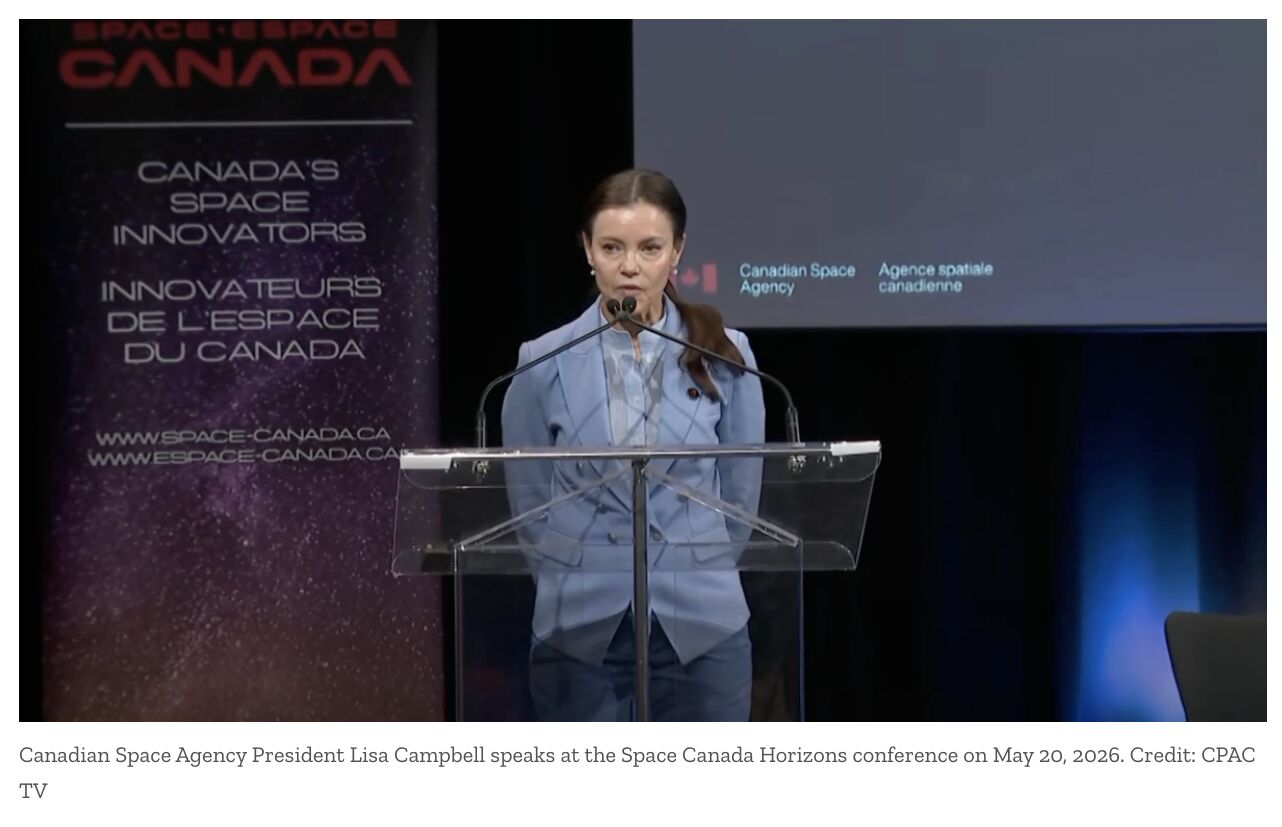
At Space Canada’s Horizons 2026 conference in Longueuil last month, that conversation moved quickly beyond industry growth. Speakers discussed national security, Arctic monitoring, commercial capability, satellite communications, Earth observation, allied cooperation, and the growing role of private-sector systems in public missions.
Similar questions have been surfacing in Canada’s geospatial community as well. At GeoIgnite 2026 in Ottawa earlier, discussions around Earth observation, AI, hydrospatial systems, emergency management, data infrastructure, and sovereignty repeatedly came back to a practical concern: Canada’s ability to understand, connect, coordinate, and respond across its own geography now depends heavily on space-enabled systems.
Space as Infrastructure
For decades, Canada’s space and geospatial sector was largely framed around scientific achievement, innovation, industrial capability, and exploration. The Canadarm became one of the country’s most recognizable technological symbols. RADARSAT established Canada as a major Earth observation player. Canadian companies and researchers built global expertise in robotics, sensing, satellite communications, and advanced geospatial technologies.
Those capabilities remain central to the sector. What appears to be changing is how closely they are now tied to the country’s everyday operational systems.
In Canada, space is now part of how wildfires are tracked, how northern communities stay connected, how ships are monitored, how weather systems are forecast, how environmental change is measured, and how emergency response is planned. It also sits behind less visible but equally important work in transportation, infrastructure, critical minerals, agriculture, and resource management.
That matters in a country where distance is never an abstract problem. The country has to monitor activity across coastlines, northern regions, remote communities, resource corridors, and infrastructure that is often far from dense ground networks. As climate risks grow and Arctic activity increases, reliable monitoring and communications become harder to treat as secondary capabilities.
Seen from that perspective, the CSA report is not only a space-sector update. It is also a reminder that many of the systems Canada relies on to understand its own geography now depend on assets in orbit.
The Dual-Use Reality
Horizons 2026 made one thing clear: dual-use is no longer a quiet subtext in Canada’s space conversation. It is becoming an official framing.
Space capability is increasingly being discussed through civil, commercial, and defence lenses at the same time. Earth observation, satellite communications, sensing, analytics, and autonomy are not only innovation strengths. They are also capabilities that support public missions, commercial services, emergency response, and national security.
In practice, this overlap is already visible. An image used to assess crop conditions or map flooding can also help build awareness of activity along a coastline or in the North. A satellite link that serves a remote community or mine site can become essential when conventional communications are disrupted.
Civil, commercial, and operational uses are now overlapping in very practical ways. A satellite program may start as an economic or research discussion, but it quickly raises questions about who has access to the data, how reliable the service is, and what happens when those systems are needed during a crisis.
Sovereignty Needs Awareness
The Arctic makes that clear. Sovereignty in the North has often been discussed through presence: ships, aircraft, patrols, bases, and people on the ground. All of that still matters. But in a region this large, presence has to be matched by awareness.
Canada needs to know where ships are moving, where ice conditions are shifting, where infrastructure may be exposed, where weather is turning, and where activity is increasing. Much of that cannot be tracked consistently from the ground.
That is why Earth observation, communications, positioning, and geospatial intelligence are now part of the sovereignty discussion. They help turn a vast and difficult geography into something Canada can monitor, understand, and respond to in time.
The challenge is not a lack of data. It is whether the right information can reach the right people quickly enough, and whether Canada has enough control over the systems it now depends on.
From Sector Growth to National Capability
The CSA report lands within a broader transition across Canada’s space and geospatial communities. The economic growth of the sector remains important. So do research investment, commercial expansion, and innovation. But many of the spring discussions point in the same direction: space is now tied to how Canada connects remote communities, monitors environmental change, coordinates emergency response, tracks infrastructure risk, and understands activity across a vast geography.
That requires a different kind of national conversation. Space can still be discussed as research, innovation, and industry. But it also needs to be discussed as infrastructure: something that requires continuity, resilience, trusted access, interoperability, redundancy, and long-term planning.
The CSA report provides the economic picture.
If space-enabled systems are becoming part of the infrastructure through which Canada operates, is the country ready to plan, protect, and invest in them that way?


Looking forward to how Canada sets up an integrted system to utilize the full potential of geospatial data to identify, define, monitorand resolve issues and possabilities at the local, and province as well as the national level. Pooviding opportunities for participation for individuals as well as communities.