

Canada’s Geospatial Strategy and the Challenge of Coordination
We unpacked Canada’s new national geospatial strategy and spoke with Sumit Gera about what it will take to make it real.
In 1972, Canada’s federal, provincial, and territorial governments sat down together and decided that geospatial coordination was too important to leave to chance. The Canadian Council on Geomatics was born, a collaborative body with a mandate to align the country’s mapping and spatial data efforts across jurisdictions.
It was, for its time, a forward-thinking move. Canada was, after all, the country that had given the world its first geographic information system a decade earlier. Coordination felt like the natural next step.
More than fifty years later, CCOG is still at the table. And Canada is still trying to solve the coordination problem.
This is not a dismissal of what CCOG has achieved. The body has enabled real collaboration, supported data sharing agreements, and built institutional relationships that make national geospatial work possible. But national coordination strategies in this sector tend to follow a pattern: ambition, enthusiasm, frameworks — and then gradual loss of momentum without strong legislative or funding anchors.
GeoConnections, which has supported Canada’s Spatial Data Infrastructure since the late 1990s, has gone through multiple phases attempting to address these challenges. Its evaluations repeatedly point to fragmentation, limited awareness, and stretched resources across the ecosystem.
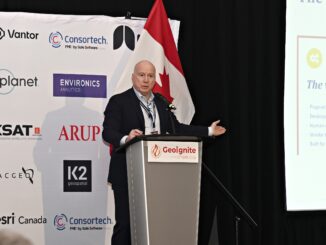
The Collaborative Geospatial Strategy for Canada, endorsed by CCOG in 2025, publicly released in 2026, and presented at GeoIgnite in May 2026, is the most comprehensive national framework to date.
It defines four missions: unlocking geospatial data, embedding it into decision-making, safeguarding infrastructure, and empowering the workforce.
The implementation clock is now running.
The man who presented it, Sumit Gera, has worked in geomatics for over thirty years. As a Senior Director at the Canada Centre for Mapping and Earth Observation (NRCan), and co-chair of CCOG’s federal table, he is responsible for helping ensure this strategy does not repeat the past.
At GeoIgnite, the message was careful and deliberate: this strategy is not about creating new data, but about coordinating what already exists.
It is about shared leadership across jurisdictions and institutions.

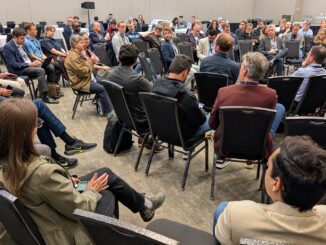
The panel that followed surfaced difficult but necessary questions.
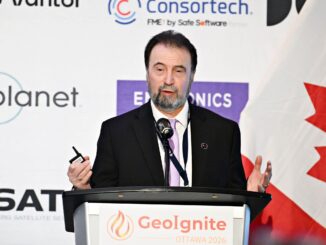
Peter Rabley of the Open Geospatial Consortium raised the central issue: how does a strategy survive contact with reality without real funding behind it?
Tanya Harrison highlighted structural silos across government, industry, and science — not just jurisdictional, but cultural and operational.
And beneath both sat a deeper question: what does Indigenous data sovereignty actually look like in practice, beyond principle?
These questions will determine whether the strategy becomes transformative — or another document in a long history of coordination efforts.
An Interview with Sumit Gera
Senior Director, Canada Centre for Mapping and Earth Observation, NRCan
GoGeomatics asks
What does the foundation look like today, and how far are we from it?
Sumit Gera, Senior Director, Canada Centre for Mapping and Earth Observation, NRCan
The foundation today is the Canadian Council on Geomatics. It is the main coordinating table for federal, provincial, and territorial governments. It is supported by the Canadian Geomatics Accord, which has recently been renewed.
But CCOG is not a legislative body. There is no legal requirement to participate. It relies on collaboration and shared commitment, which means momentum can shift over time depending on governments and priorities.
We are both closer to, and further from, the foundation than we have ever been.
GoGeomatics asks
Is there real funding behind the strategy?
Sumit Gera, Senior Director, Canada Centre for Mapping and Earth Observation, NRCan
The CCOG itself has a very small budget. It is not an investment fund.
Implementation depends on aligning the strategy with existing investments — such as flood mapping and satellite Earth observation — rather than creating entirely new funding streams.
The goal is to reduce duplication and improve alignment across departments so resources are used more effectively.
GoGeomatics asks
What does Indigenous data sovereignty look like in practice?
Sumit Gera, Senior Director, Canada Centre for Mapping and Earth Observation, NRCan
Indigenous data sovereignty is embedded in the strategy through engagement with Indigenous experts and organizations.
We are working to ensure Indigenous representation in governance structures and exploring broader advisory mechanisms that include Indigenous voices alongside industry, academia, and government.
It is an ongoing process, not a completed outcome.
GoGeomatics asks
What is different this time?
Sumit Gera, Senior Director, Canada Centre for Mapping and Earth Observation, NRCan
The pressure has changed. Departments can no longer operate in isolation without inefficiency becoming a liability.
AI, data growth, and fiscal constraints are forcing interoperability. Coordination is no longer optional — it is becoming essential for survival.
GoGeomatics asks
What would failure look like?
Sumit Gera, Senior Director, Canada Centre for Mapping and Earth Observation, NRCan
Failure would be losing the diversity of voices that built the strategy.
If accountability mechanisms and performance tracking are not in place, the strategy risks becoming a document rather than a working framework.
Measurement and follow-through are critical.
GoGeomatics asks
What does your perspective bring to this work?
Sumit Gera, Senior Director, Canada Centre for Mapping and Earth Observation, NRCan
The focus is on clarity of purpose — understanding users, aligning with government priorities, and ensuring real-world delivery.
Technical depth is important, but so is accessibility. The system only works if it serves people outside the technical community as well.

Be the first to comment