
As the U.S. proposes deep cuts to NASA and NOAA, climate scientists warn of lasting damage to the global systems we rely on to track a changing planet.
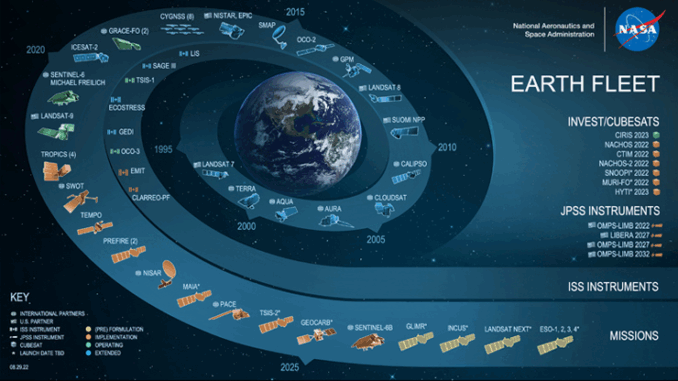
In 1972, the U.S. launched Landsat, the world’s first Earth Observation satellite. It was a landmark moment – one that reflected vision, urgency, and a long-term commitment to monitoring the planet from space. What followed was five decades of data that helped us understand everything from melting glaciers and deforestation to rising sea levels.
Now, in 2025, that legacy is under threat.
NASA – the same agency that led the charge in Earth Observation – faces what scientists are calling an “extinction-level event” for its climate science missions. Budget documents reveal sweeping cuts to both NASA and NOAA, stripping away support for the programs that help us understand how the planet is changing. Cuts that arrive just as the climate crisis is accelerating.
This Isn’t the Time to Look Away
We are seeing the effects of climate change all around us. Wildfires that burn hotter and longer. Hurricanes that form faster and leave more destruction behind. Floods in places that never used to flood.
In 2024, the planet hit its hottest year on record. Again. That makes ten consecutive years – 2015 to 2024 – all of them breaking heat records. Scientists have warned for years that we are approaching a dangerous climate tipping point.
In 2024 again, global sea levels rose by 0.59 cm – nearly double the expected annual rise. Over the past few decades, the ocean has crept up by more than 10 cm – a direct result of the warming climate. It’s enough to threaten cities, coastal infrastructure, freshwater systems, and entire communities.
And it’s not just the science. The money tells the story too. Climate-related disasters in 2024 alone racked up $310 billion in global damages. That figure isn’t an outlier – it’s part of a trend. Fires, droughts, floods, storms. More frequent. More costly. More deadly.
NASA and NOAA are the Frontline
NASA and NOAA aren’t just space or regulatory agencies. They are the core of the U.S. climate science infrastructure. Their satellites monitor the critical signals such as carbon emissions, soil conditions, weather forecasts, sea surface temperatures, ocean acidity, polar ice loss… Things we simply can’t see from the ground. This data is essential for informing policies that cover everything – from urban resilience to agriculture and disaster management.
The data they collect is also used by researchers and policymakers across the globe. It shapes everything from emergency response plans to global climate treaties. If we lose that capability – or even scale it back – the world loses a key piece of the climate puzzle.
And that’s why the backlash to these proposed cuts has come fast and loud. Even Elon Musk – hardly a defender of big government – called the move “troubling.” That’s noteworthy, given Musk’s active role in slashing government expenditure and persistent speculation that he stands to gain if NASA scales back and the private sector steps in.
The World isn’t Waiting
While the U.S. debates cuts, other countries are moving forward.
The European Union has been expanding its Copernicus program – already the largest EO initiative in the world. The EU isn’t just launching more satellites. It’s building policy frameworks, forming partnerships, and weaving EO data into everything from agriculture to disaster planning.
China, too, is rapidly building its space-based environmental monitoring. The country’s 14th Five-Year Plan includes targeted investments in Earth Observation to track carbon emissions and deforestation. In 2024, it strengthened its long-running partnership with Europe through the Dragon Program – now in its sixth phase – which focuses on climate data, land monitoring, and atmosphere modeling.
Meanwhile, organizations like the United Nations and World Meteorological Organization (WMO) have been vocal about the need for more investment in space-based EO. WMO’s State of the Global Climate 2023 report called for increased international cooperation and funding to expand the global network of EO satellites.
The U.S. is Pulling Back Instead
It’s not just a step in the wrong direction — it’s a step out of the room.
As the rest of the world increases funding, strengthens alliances, and integrates satellite data into policy, the U.S. appears poised to retreat. Slashing budgets for NASA and NOAA sends a clear message: that climate research is optional. That global leadership in Earth science is no longer a priority.
But the climate crisis doesn’t care where the data comes from or where the cuts are made. It doesn’t stop at borders, or spare one country because another turned away. The atmosphere is shared. The oceans are shared. And so is the responsibility.
The world never looked at NASA and NOAA as American institutions. They are part of a global infrastructure — scientific, humanitarian, environmental — that millions around the world rely on. What the U.S. does with its agencies is, of course, its decision. But that decision carries consequences far beyond its borders.
Cuts like these don’t just slow progress. They signal that the U.S. is stepping back from the kind of leadership the world urgently needs.
History will ask what we did. It always does.
When the science was clear and the warning signs were everywhere, did we invest in the tools to understand and respond? Or did we stand by as those tools were dismantled — knowing full well what was at stake?



Be the first to comment