
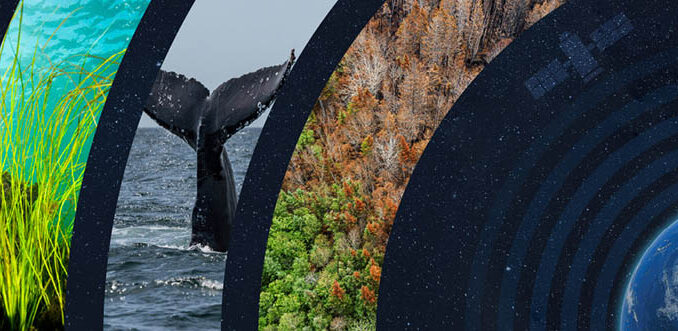
Five companies have now been selected to advance to Stage 2, according to the Canadian Space Agency. In this next phase, companies received up to $780,000 to develop and demonstrate their proposed solutions for business and government users.
C-CORE to mitigate Arctic challenges using artificial intelligence

Mission Control to demonstrate onboard satellite detection for real-time wildfire response
As climate change drives hotter, drier conditions, wildfires in Canada and around the world are becoming increasingly frequent and intense, threatening lives, infrastructure and the environment. Wildfire first responders need timely satellite data to inform their decisions during critical situations.
Mission Control is developing a machine learning application for use onboard satellites to deliver wildfire detection products that can be relayed to wildfire managers in near real time. They will gather and refine new wildfire training data using drones and satellites and deploy the resulting algorithms to Mission Control’s Persistence satellite. The algorithm will detect wildfires onboard and demonstrate the value of the application to future wildfire detection satellite missions and users.

Hatfield to develop eelgrass mapping system
Canada’s coastal eelgrass beds are declining due to a range of climate change-related threats. This calls for detailed, large-scale mapping to assess their impact on fish populations and aquatic biodiversity, and to guide conservation efforts.
Hatfield will use satellite data and artificial intelligence techniques to map eelgrass beds at large scale – over the entire coast of British Columbia – addressing current gaps left by localized field studies and aerial surveys. This will benefit habitat restoration and Marine Protected Area management.

AltaML to develop AI modelling using satellite data to protect whales
A significant challenge in using satellite imagery and artificial intelligence (AI) modelling to detect and monitor whales is building the right databases to train and test the AI models to recognize whales.
AltaML will use advanced AI techniques to create a database of realistic synthetic images, which will later be used to train AI models with real satellite data. This project would help protect large aquatic animals and aid researchers to understand their behaviour and impact on the ecosystem.

Fluvial Systems Research to integrate satellite data into North Atlantic right whale protection measures
Protecting North Atlantic right whales (NARW) in Canadian waters, while maintaining commercial shipping and fishing operations, is a key challenge. NARWs are hard to detect in the open ocean because they constantly move across their large migratory and feeding areas.
Fluvial Systems Research will validate and perform operational demonstrations of a three-step methodology using satellite data to detect and monitor the movement of the whales. This project could provide additional NARW locations to Fisheries and Oceans Canada’s Whale Insight platform, improve detection probabilities, and enhance situational awareness for Transport Canada in shipping lanes.



Be the first to comment