
By Nadine Alameh, with the GoGeomatics Editorial Team
As GeoIgnite 2026 approaches this May 11–13 in Ottawa, GoGeomatics spoke with keynote speaker Nadine Alameh about the rapid evolution of GeoAI, the rise of natural language interfaces, and the shift from traditional geospatial tools toward live decision systems.
Her perspective reflects a major transition now underway across the sector. Geospatial technology is no longer only about maps, dashboards, and specialist workflows. Increasingly, it is becoming embedded inside decision-making itself.
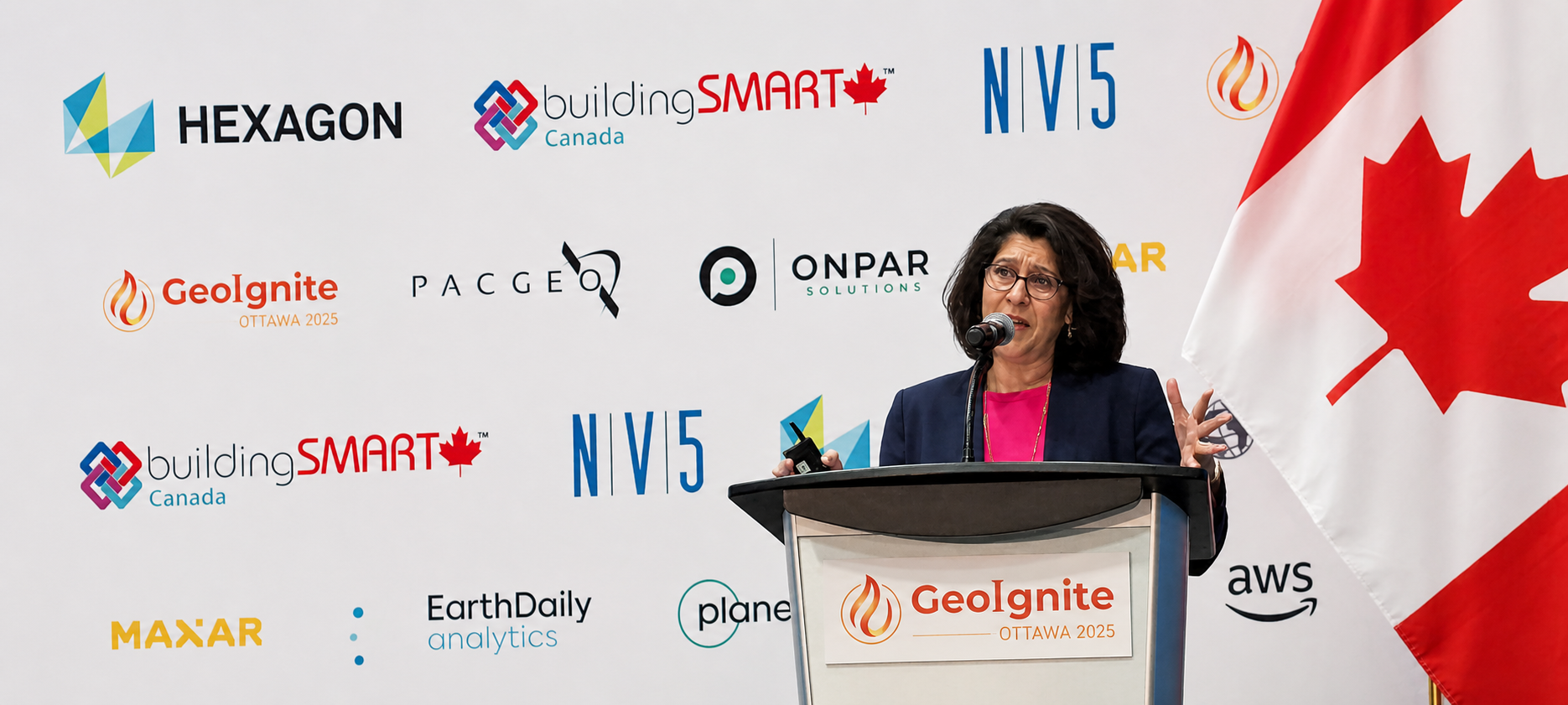
Nadine Alameh speaking at GeoIgnite in Ottawa.
Key Themes
GeoAI • Decision Systems • Intelligent Agents • Trusted Data • Geospatial Leadership • Natural Language Interfaces
From Maps to Decision Loops
We live in remarkable times. And I am grateful to have a front seat in these times due to my involvement in amazing global innovation initiatives like the Amazon Web Services GenAI MEA/Europe/Africa challenge, the work with Duality.ai on simulation and synthetic geospatial data, and the UK GeoAI Festival. These initiatives confirm to me that there’s definitely a shift happening, and it’s happening fast.
Throughout our careers, we have used geospatial technologies to ingest, layer, integrate, and analyze data about the Earth. We built maps, dashboards, and models to support decisions across urban planning, transportation, logistics, disaster response, and beyond. We developed predictive analytics to estimate wildfire damage, model disease spread or assess the impact of infrastructure and policy changes. In short, we built applications to help us understand, predict, and decide.
What’s changing now is the interface and with it, the entire paradigm.
With the rise of GenAI and natural language interaction, users no longer need to construct the analysis. They can simply ask the question.
The user doesn’t even need to think in “geospatial” terms anymore.
Instead of assembling layers, defining buffers, or building models, a user can ask: “Where is the best place to build a new data center?” or “What’s the potential impact of the upcoming storm on the city?”
The system then orchestrates everything behind the scenes — discovering relevant datasets, running analyses, even executing simulations, and returns not just an answer, but increasingly, a justification.
We are already seeing early versions of this in AI assistants and “ChatGPT-for-geo” experiences expanding the concept of ChatGPT that we’re all getting increasingly familiar with, regardless of our industries or our ages.
Questions like: “How will tomorrow’s snowfall affect my deliveries?” or “Which assets in my portfolio are exposed to compounding climate risks over the next five years?” are inherently spatial but the user never has to say so.
We are moving from maps and dashboards to live decision loops and ultimately, toward embedded autonomy.
GeoAI: Between Real Impact and Structural Friction
I recently hosted the UK GeoAI Festival salon dinners, where I had the privilege of convening roundtables with senior leaders across government, industry, and academia. What I learned is that, while there’s increased experimentation with GeoAI in the public sector, there is still a persistent struggle to move from experimentation to sustained, system-wide delivery.
GeoAI is both overhyped and underutilized.
The scaling challenge is not just technical, it’s also structural and institutional.
We are definitely seeing meaningful, operational deployment in domains where three things exist: clear demand, mature data pipelines, and measurable outcomes. Think about domains like defence and intelligence, disaster response, environmental monitoring, climate modeling, agriculture, etc. We definitely see many instances where GeoAI is informing real decisions in these fields, even in near real time.
What I learned from the UK experience is that we tend to overestimate how quickly GeoAI can scale across entire organizations or sectors. The limiting factors are often not the models or the data, although we do carry a lot of debt in the metadata department, which is critical for AI. The limiting factors are more how GeoAI is framed, commissioned, and embedded in organizations.
Long story short, GeoAI should not be a side experiment. It really should be a core decision-support capability, embedded across workflows, systems, and everyday operations.
Success requires starting with real problems, not tools. Clear problem definition and continuous engagement with end users, especially in the public sector, are essential.
In the era of generative and agentic AI, trust doesn’t happen by default. It depends on governance, data provenance, transparency, accountability, and human oversight.
To move from pilots to impact, we need stronger collaboration between governments and the private sector, aligning public value with economic incentives and reducing fragmentation across the ecosystem.
From Platforms to Orchestrated Intelligence
Imagine moving away from monolithic platforms toward ecosystems of intelligent agents, millions of them, working in coordination.
These agents can task satellites and drones, discover and procure data, access historical archives, run algorithms and simulations, clean and process information, generate maps and applications, and continuously learn and improve.
Now imagine them working alongside us in real time — supporting analysis, simulating scenarios, answering questions, and collaborating on decisions. This is the future. And this future is closer than we think.
This is not about throwing everything away. Our existing systems become the foundation, but they need to evolve.
Decision-makers are not interested in geospatial or AI for their own sake. They want reliable answers to their problems.
With AI, it’s all about the data at the end of the day. Questions of data quality, metadata, lineage, and governance become mission-critical.
Moving from local files and desktop environments to cloud-native, streaming-ready architectures is key. Formats like COG, PMTiles, and GeoParquet enable interoperability and scale.
Instead of tightly coupled platforms, we are moving toward loosely coupled, API-driven ecosystems where agents can discover, access, and act across services.
Technologies like DuckDB, Spatial SQL, Python, and increasingly natural language interfaces are expanding who can interact with geospatial data and how.
Organizations need to build on what they have, modernize their data and infrastructure, adopt new orchestration patterns, and rethink workflows around speed, adaptability, and user needs.
The Expanding Role of the Geospatial Professional
This is the question of the day, isn’t it? And not just for geospatial. We are fortunate to be working in this field at this moment in history.
My own journey started more than 25 years ago, inspired by a vision of planetary intelligence, where data about our world meaningfully informs how we govern, invest, protect, plan, and respond. Today, that vision is no longer aspirational. It’s within reach.
We are uniquely positioned in this shift. We sit at the intersection of data, technology, and real-world decision-making. That puts us in a powerful role.
As connectors, bridging silos across domains. As integrators, bringing together diverse datasets and systems. As disruptors, rethinking how decisions are made at scale.
As AI lowers the barrier to entry, we can reach far more users than ever before. At the same time, the value of domain expertise is increasing, not decreasing.
Without context, answers can be misunderstood or misused. Context comes from experience, from understanding the nuances of data, the limitations of models, and the realities on the ground.
There is still a need for geospatial professionals to design and manage data architectures, validate, fine-tune, and augment models, ensure data quality, lineage, and integrity, audit workflows continuously, translate outputs into real-world decisions and policies, and ensure orchestration of AI-driven workflows is trustworthy and explainable.
The challenge is not just a shortage of data scientists but a broader gap in spatial and analytics literacy.
The future requires more cross-disciplinary thinking and hybrid skill sets that combine geospatial, data science, AI, policy, and domain knowledge.
The role of geospatial professionals is not diminishing. It’s expanding.
The role of geospatial professionals is not diminishing. It’s expanding from map makers, analysts and technical experts to decision enablers, orchestrators, validators, and strategic leaders.
Continue the Conversation at GeoIgnite 2026
Nadine Alameh will join GeoIgnite 2026 in Ottawa, May 11–13, as part of the national conversation on geospatial leadership, GeoAI, digital infrastructure, and the future of decision systems.


Be the first to comment